Falklands
War Jottings – 30 years on……………
I
was requested to write a piece for 'Full Ahead', the Merchant Navy Association
Magazine, which was published in the Summer 2007 edition.
_____________________________________________________________________
“The Falklands War will
go down in history as one of the most brilliant maritime operations of the
twentieth century. Certainly, everything about it – the incredible speed with
which the Task Force and its specialist supporting shipping were assembled and
manned; the ingenuity and improvisation which were displayed in modifying those
ships and their equipment to meet a whole multitude of tasks was remarkable.”
Captain David Hart Dyke MVO, CBE, RN – Commanding Officer HMS Coventry.
The United Kingdom
’s strategic use of merchant ships was never more in evidence than during the
1982 Falklands War. Faced with
insufficient troop and military transport lift capacity, the necessary Statutory
Instruments were signed on 3rd April, in order to permit the Ministry
of Defence to
take ships up from trade. 54 merchant ships were taken up from trade (STUFT) to
assist the armed forces during the
South Atlantic
conflict. 43 sailed for the
South Atlantic
with Merchant Navy crews and Naval Parties embarked, before the Argentine
surrender on 15th June. 5
deep sea trawlers were taken up from trade, manned by the RN and used as
Minesweepers. The first ship to be 'STUFT' was the P&O flagship
Canberra
, Master : Captain Dennis Scott- Masson, homeward bound for
Southampton
with a full complement of cruise
passengers. She embarked two full Commandos and 3
Para. Much of their heavy equipment and ammunition, as well as eight light
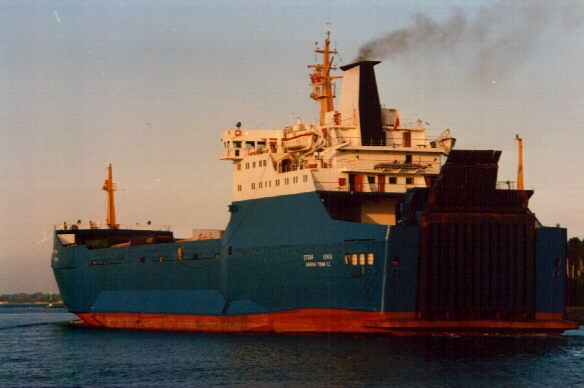
Scimitar tanks of the Blues and Royals, was loaded into the P&O
Roll-On-Roll-Off ferry Elk, Master: Captain John Morton. John had extensive experience
of the Antarctic, having once been a deck officer with the British Antarctic
Survey.
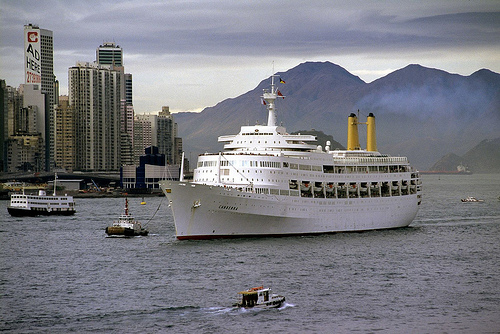
P&O's Flagship, SS Canberra
P&O Ferry's MV Elk
During 1981, I had sailed as the Convoy
Commodore's First Lieutenant on the major NATO Exercise, Ocean Safari, from
which lessons were learned, resulting in my giving a paper at the Post-Convoy
Conference at the Naval Academy in Lisbon. The subject was 'The Integration of
Merchant Shipping into a Naval Task Force for out of NATO area operations. At
the time I was a lecturer on the staff of the Maritime Trade Faculty at the
School of Maritime Operations, Portsmouth.
On 6th April I
was ordered to report to the Headquarters of the Commander in Chief of the
Fleet, Northwood, Middlesex – an underground NATO bunker, known throughout the
military as ‘the hole’. Guarded
by heavily armed Royal Marines, it was an impressive place, and like an iceberg,
most of it was hidden well below the surface.
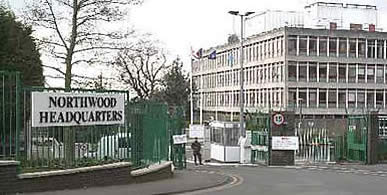
Once briefed by Commander
Tom Allen RN, Staff Officer Naval Control of Shipping, my first task was to get
the salvage tugs away. Captain Freddie Fox, Assistant Chief of Staff Operations
and Plans and our immediate boss asked me to work out how long it would take
them to reach the
Falklands
area. I found a chart of the
Atlantic Ocean
, north and south, and ran off the distance with a pair of borrowed dividers.
With eight thousand nautical miles to steam, it would take them the best part of
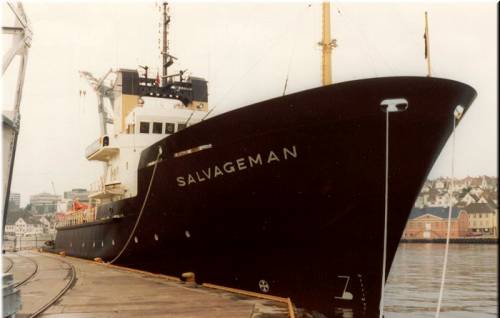
a month. Irishman,
Salvageman and Yorkshireman had already been requisitioned and were
deployed to
Portsmouth
. A naval car was organised and I set off down the A3. After briefing their
Masters, Captains W.Allen, A J
Stockwell and P.Rimmer - and supervising the loading of
additional equipment, I informed the Queen’s Harbour Master in his
lofty eerie, the semaphore tower overlooking Portsmouth Naval Base, that the
tugs were in all respects ready for sea, and waved them off with a somewhat
heavy heart. Eight thousand miles of inhospitable sea is a long way to go in a
seven hundred ton salvage tug. Each had a small Royal Maritime Auxiliary Service
party embarked and were as prepared as civilians can ever be for the daunting
tasks that lay ahead.
Following the departure of the salvage tugs, there was
a steady stream of STUFT to brief
and equip with replenishment gear, radio equipment compatible with that of the
fleet, commercial satellite communications systems, additional fuel tanks, fresh
water production plants, extra accommodation and facilities for operating
helicopters. Portsmouth Dockyard led the way, with as many as five merchant
ships at a time being fitted out, during the period 8th April to 21st
May. A total of twenty-five tankers,
freighters, tugs and short-sea ferries were modified there, under the expert
management of the Royal Corps of Naval Constructors – who were celebrating
their centenary. I remember arriving at Devonport, early one morning, courtesy
of an RAF Gazelle helicopter. As we hovered above the landing pad, Sea
Container’s MV Contender Bezant, was
being warped into a dry-dock. By the time I arrived onboard, oxy-acetylene
torches were burning brightly and steel was already being cut. She was soon
underway, with a Sea King, 2 Wasps, 4 Harrier GR3s, 4 Chinooks and 2 Gazelle
embarked. On returning to my cabin at
Northwood two days later, at around 04:00, I discovered all my kit piled outside
the door in bin bags and an RAF Group Captain snoring loudly in my bed. After an
unfriendly altercation, which only served to reinforce my opinion of RAF senior
officers, I made my way into the underground bunker and informed the duty
officer, Captain Jeremy Reed, Assistant Chief of Staff (Warfare). "Some bloody
crab has nicked my pit, Sir!" I complained, somewhat peevishly. "Leave it to me
Nick", replied the kindly Jeremy, urging me to follow him topside. Explaining to
the sleepy RAF-type, in no uncertain terms, that "some of us are fighting a
rudddy war and NATO staff can sling their hooks", he evicted the pyjama clad
groupie, which quickly saw me reunited with my bunk, where I was able to snatch
forty-winks before resuming watchkeeping duties in the underground STUFT cell at
07:00.
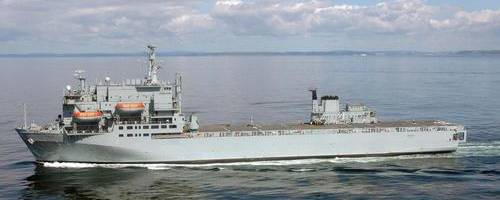
MV Contender Bezant
Elk arrived at
Ascension Island on 20th April, having refuelled at
Freetown
en route and quickly earned a tremendous reputation as a key element of the
Task Force. Fitted with Satcom, Crypto, Extra Fuel Tanks, RAS (Replenishment At
Sea) Astern Rig and VERTREP (Vertical Replenishment by Helicopter) equipment,
her enthusiastic ships company quickly pressed her case as a ‘ship of the
line’. With the assistance of Army
Engineers, her bulwarks were cut away to give her a Chinook heavy lift
helicopter landing spot, while up forward, a hangar was constructed, capable of
housing three RN Sea King helicopters. Meanwhile, the focsle mounted a pair of
40/60 calibre Bofors anti-aircraft guns. One gun being manned by the MN and the
other by the ship’s embarked Naval Party. For extra firepower, the Scorpion
light tanks were ranged on deck in such a way as to provide a broadside, in case
the opportunity arose to engage an enemy vessel at close quarters, in true
Nelsonian style. Plans were also considered to use the steel that had been cut
away from the bulwarks to construct a Sea Harrier ski jump – but were later
shelved – much to the disappointment of Captain John Morton and his Merchant
Navy crew. In his report dated 16th
April, Captain Morton stated: ‘A great variety of emergency drills,
intelligence briefs, first aid lectures, vehicle running, weapons training and
physical jerks continued throughout the day with the ship’s staff,
surprisingly enough, joining in. The last time I saw the cook-convenor, he was
learning to strip and re-assemble a machine gun.’
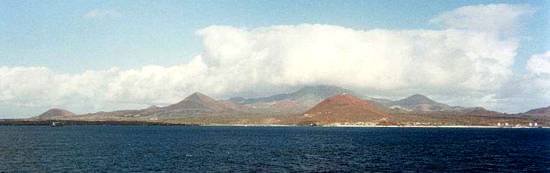
Ascension Island
Elk
sailed from Ascension as part of the Amphibious Warfare Task Group, tactically
loaded for support of an amphibious landing and with a full complement of
helicopters. The group, which also included Canberra, Norland, Europic Ferry
and Atlantic Conveyor, together with HMS Intrepid and HMS
Fearless, sailed from Ascension on 7th May, fully darkened,
without navigation lights, and with radar and radio silence imposed. Elk
was to make three overnight runs into
San Carlos
water, to land essential stores and vehicles and re-supply rations and
ammunition. Captain Morton was later
awarded a well earned CBE in the Falklands Honours List.
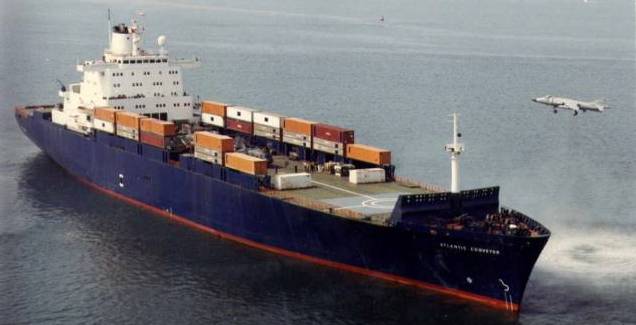
MV Atlantic Conveyor
The P&O School Ship SS
Uganda was requisitioned at
Alexandria
on 10th April, disembarking her school children at
Naples
and arriving
Gibraltar
on the 16th. She was
declared in accordance with UN regulations as a hospital ship and adorned with a
large red cross on both sides of her immaculate white hull. Surgeon Captain
Snow, the Fleet Medical Officer and I had to scour the Korean War archive in
order to find the correct routine for fitting out a hospital ship. The
regulations were strict: no secure communications equipment and definitely no
weapons – not even for self defence. I will never forget the look of
disappointment on the face of the Fleet Missile and Gunnery Officer, when I
informed him in no uncertain terms, that he was not going to mount his fifty-calibre
general purpose machine guns on
Uganda
’s
immaculately holy-stoned bridge wings.
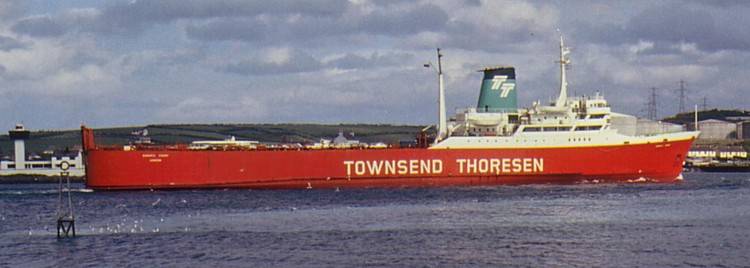
MV Europic Ferry
The Townsend Thoresen
Company’s Europic
Ferry sailed from
Southampton
on 23rd April, under the command of Captain Chris Clarke. Chris and
I had sailed together as Third and Fourth Officers in
the Orient liner Orcades. We were good friends and it was with
mixed emotions that I shook his hand and said my goodbye. Loaded with a mixed
cargo of 105mm light guns, ammunition, vehicles, fuel, aircraft and equipment
for the Second Battalion the Parachute Regiment, 29 Battery Royal Artillery and
656 Army Air Corps, she made a brief call at Ascension, where she joined the
Amphibious Group, under the command of Commodore Mike Clapp RN,
COMAW - Commodore Amphibious Warfare.
On 17th May they met up with the carrier battle group, under
the command of Rear Admiral Sandy Woodward, and began final planning for the
amphibious landing. The following
day, Europic
Ferry went to action stations for the first time in earnest, ‘Air Raid
Warning Red’ sounding throughout the ship, as incoming enemy aircraft were
detected.
It had been pointed out
that the ship’s red hull and high, bright blue funnel, made a good aiming mark
for incoming Argentine aircraft. Resilient
to a man, the crew turned to, with stages rigged and pots of paint to hand, they
bravely went about the task of repainting the funnel battleship grey. And as
each air raid was broadcast, the crew shuffled round to the down-threat side,
and continued painting there until the threat had subsided and the all clear
sounded – whereupon they resumed painting the up-threat side again. Captain
Chris Clarke was awarded a well deserved OBE in the Falklands Honours List,
which he modestly accepted on behalf of his stalwart Merchant Navy crew.
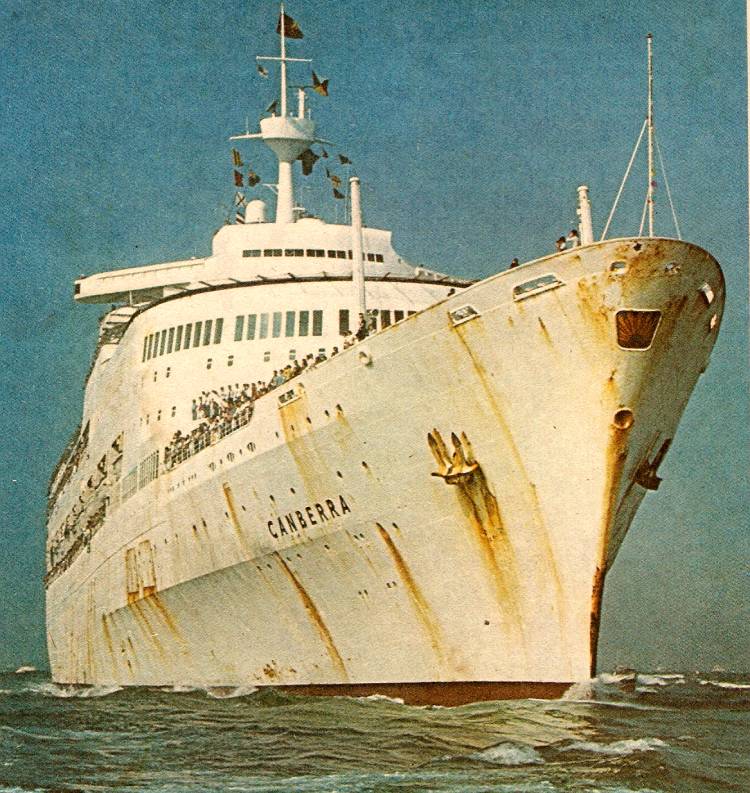
SS Canberra, The
Great White Whale, flagship of the mighty P & O, came to represent all that
is best about the British Merchant Navy – courage, flexibility, innovation and
dedication in the service of Queen and country. I was fortunate to have been
there at Southampton on 11th July, along with my four-year old son
Timothy, as she hove into view, rust streaked and worn, her decks thronged with
the men of 3rd Commando Brigade, Naval Party 1710 drawn up smartly on her
forward flight deck, and a Royal Marines band playing their hearts out - drowned
by the roars and cheers of the assembled crowds of well-wishers, welcoming her
home. Will we ever see such a magnificent sight again?
Canberra
transported 2,400 men to the Falklands War and carried 4,400 weary, defeated
Argentines safely home again after their surrender. Captain ‘Beagle’ Burn
RN, commanding Naval Party 1710 reported that at
San Carlos
and elsewhere, a first class P & O ‘geriatric passenger landing and
reception organisation’, manned by the Senior Assistant Purser, and the
gallant ladies of the Bureau, took Royal Marines, Welsh Guards and Argentineans
in its stride. The 4,400 POWs were handled, for convenience sake, as P & O
luggage; each man had a company luggage label, coloured to denote the
appropriate deck, attached to his left shoulder throughout his stay onboard. The
ship operated without an engine room breakdown for the 13 ½ weeks of her
deployment and Captain Burne reported that the P & O Deck Officers were of a
particularly high calibre, “seeming to relish the pace of military activity,
compared to their normal cruising routine. The niceties of life aboard a P &
O Liner were not allowed to be interrupted by hostile action either, and each
day, come hell or high water - underway or anchored in
San Carlos
water, pink gins were served on the bridge at noon. I had the privilege of
serving under Captain Dennis Scott-Masson,
Canberra
’s Master, in 1972 when
I was First Officer of the
SS Chusan. A
courteous, dignified, kindly Captain, he was a superb seaman and the very
epitome of an ocean liner captain. His CBE in the
Falkland
’s Honours List was a worthy reward for his loyal service to both company and
nation.
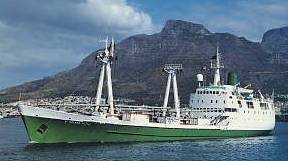
MV St Helena
The Curnow Shipping
Company’s
Motor Vessel St
Helena
, under the command of Captain M L M Smith MN, sailed in company with HM Ships Brecon and Ledbury
on 13th June. Her role was that of
a Mine Hunter Support Unit, and she had been extensively modified to fuel and
store her two valuable ‘charges’ while underway. A helicopter hangar and
flight deck were constructed aft and an RN Wasp Flight embarked. Thirteen
containerised modules were loaded, seven of which were in constant use as
workshops and offices during her deployment. We jury rigged a lightweight hose
handling system, under the flight deck, which could be used to refuel the mine
hunters astern in heavy weather. It consisted of a high tech Kevlar hose, which
we ‘borrowed’ from the US Marines. Folded flat it took up very little room
and had been designed to refuel helicopters as they hovered above the tree
canopies of
Vietnam
. The hose reel itself was modelled on my mother’s garden hose device, only
much bigger and driven by a compressed air motor. Years later, I was attending a
presentation by the Royal Naval Corps of Constructors at Bristol, and was amused
to see my ‘invention’ highlighted by the speaker, as a ‘Heath Robinson
gadget invented by an RNR Officer - just another example of the ad hoc
improvisation and innovation that was the order of the day in 1982’.
From 10th July to 14th August
St
Helena
served as mother ship to the MCMVs as they hunted for mines in Falkland Sound.
There is one incident
that has caused me many a chuckle down the intervening decades. It took place
onboard the Ocean Fleets heavy lift cargo ship Myrmidon, while loading at
Sunderland
. I was in the process of briefing her amiable Master; whose name I’m afraid
now escapes me. His wife and daughter were staying onboard while the ship was
alongside, and had popped ashore for a spot of shopping. We were just getting
started on ‘darken ship and evasive manoeuvring’, while beyond the
captain’s big cabin window, a large wooden crate, clearly marked ‘PORT
STANLEY’ hove into view, the union purchase gear humming as it was carefully
swayed into position over number
three hold. “You told me you were going to
Hong Kong
!” exclaimed a woman, suddenly
from behind us, as she stepped across the threshold. It was the Captain’s
wife, laden with carrier bags, just returned from shopping. “We’ll see about
that!” shouted the Captain, completely unperturbed, hurrying to the starboard
side of his vast suite and stepping out onto his private sundeck. “Get that
off my ship!” he bellowed, “we’re not going to the ruddy
Falklands
!” He very nearly got away with the subterfuge, but then his daughter
appeared. She was at university and knew all about electronics. “Amazing
secure comms equipment being installed in the radio shack, Dad. I’ve just been
chatting to your Royal Navy communications team. All terribly hush-hush!”
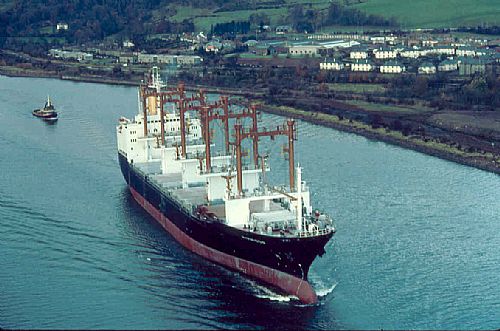
Myrmidon,
above, and Sapele
of Ocean Fleets, transported hutted accommodation and much needed stores
to
Port Stanley
.
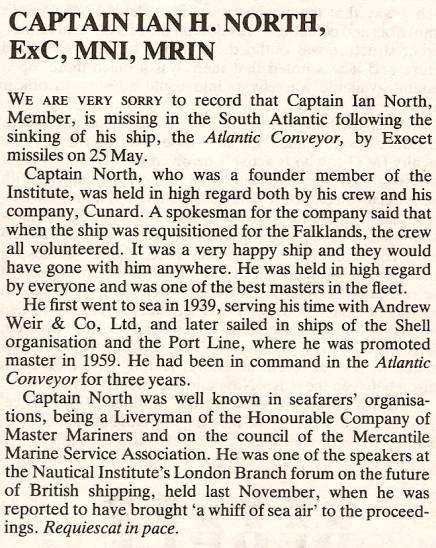
The Nautical Institute's
announcement of the loss of Captain Ian North, DSC, MNI, MN
Master, MV Atlantic
Conveyor
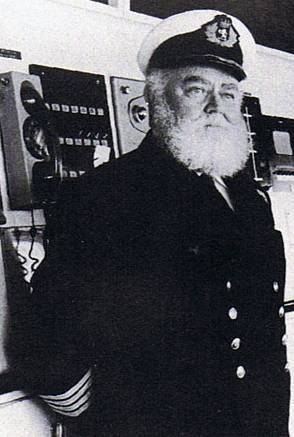
Captain Ian North, DSC, MNI, MN
It is known that Ian North successfully abandoned the ship,
but could not make it from the rope ladder to the life raft. He disappeared,
possibly following a heart attack induced by the very cold water. He has no
living relatives, and was unmarried. His officers liked him very much and
especially his ecentricities, which included clever cartoons sketches of people.
Perhaps the loveliest tribute to him comes from Captain Jorge Colombo, the
commanding officer of the very effective Super Etendard squadron which sank the
Atlantic Conveyor as well as HMS Coventry. He has written "Captain North was a
real sea-dog with his snowy beard, he was a great and brave man. And when I
think of him, I think of these lines by the English poet John Masefield:"
"I must go down to the sea again,
to the lonely sea and sky,
and all I ask is a tall ship,
and a star to steer her by.
And the wheel's kick,
and the wind's song,
and the white sails shaking,
and a grey mist on the sea's face,
and a great dawn breaking ..."
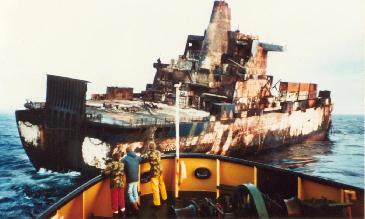
The 'butcher's bill'
was high, too high by far.
In the war against Napoleon, when
Admiral Nelson wanted to know how many people were dead, he'd yell to his
orderly, "What's the butcher's bill for today?"
Great Britain’s national maritime fighting force was born in the 14th
century, and for three-hundred years or so, the Royal and Merchant Navies were
nigh on indistinguishable and interchangeable, in terms of both ships and
personnel. Thereafter, although the warship evolved into a dedicated fighting
machine, merchant ships continued to be used for military purposes, and on
numerous occasions, provided the essential support of men and materiel, without
which the Royal Navy could not have achieved many of its greatest victories.
I will leave the last
words to the illustrious naval commander, under whom it was my immense privilege
to have served, the late Admiral of The Fleet, The Lord Fieldhouse of Gosport GCB,
GBE, Royal Navy. ‘He was an
inspired leader’, wrote Baroness Margaret Thatcher. ‘His unruffled and easy
manner at times of great crisis calmed and steadied all those around him, and
his unwavering belief in victory lifted our spirits even in the blackest
hours.’
Admiral Sir John Fieldhouse said:
“ I cannot say too often or too clearly how important has been the
Merchant Navy’s contribution to our efforts. Without the Ships Taken Up From
Trade, the
Falklands
operation could not have been undertaken, and I hope this message is clearly
understood by the British nation. In April of 1982, the Merchant Navy went to
war in 48 hours. That first weekend in April, the industry swung into its role
as our nation’s ‘fourth arm of
defence’.”
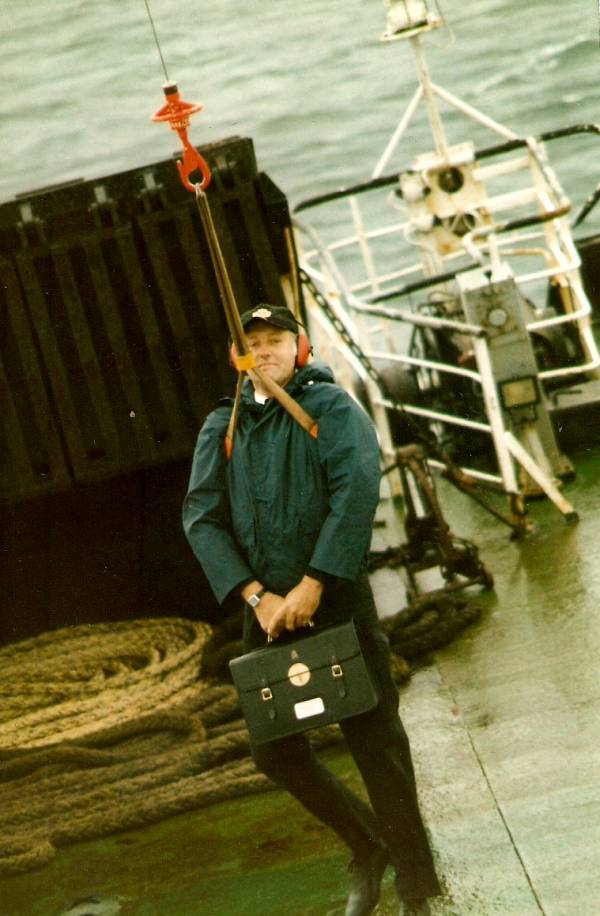
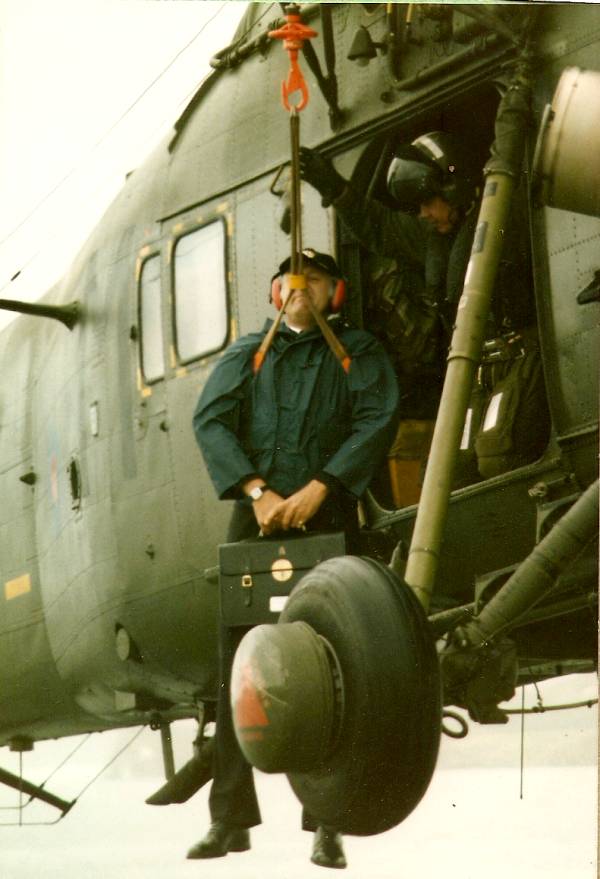
The Boarding Officer departs.......
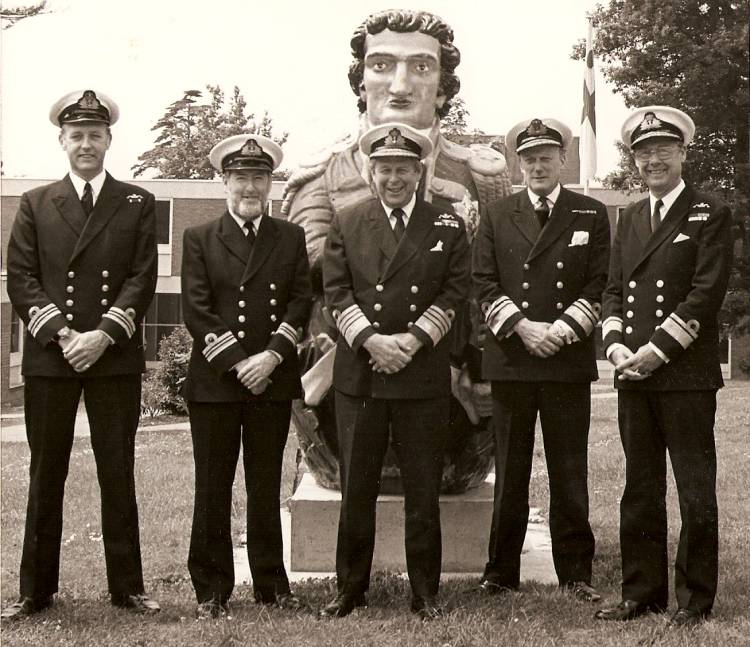
In the presence of greatness, HMS Warrior, Northwood
Middlesex.
Left to right:
Myself; Lt Cdr R E A Shrub, Fleet Press Officer; Admiral of The Fleet Sir
John Fieldhouse,GCB,GBE, Commander in Chief of the Fleet, Commander Task
Force 317; Admiral Sir David Halifax, KCB, KCVO, KBE, Chief of
Staff; Rear Admiral Peter Hammersley CB,CBE, Fleet Engineering Officer.
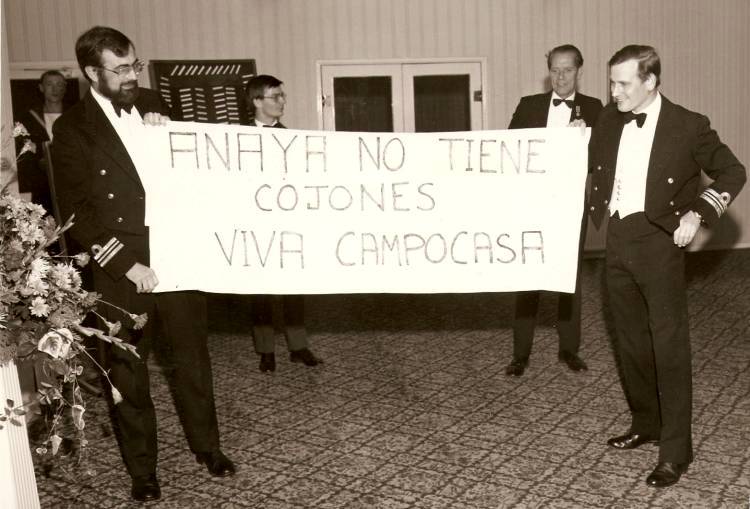
A
picture is worth a thousand words......
First
mess dinner at Northwood following the cessation of hostilities.
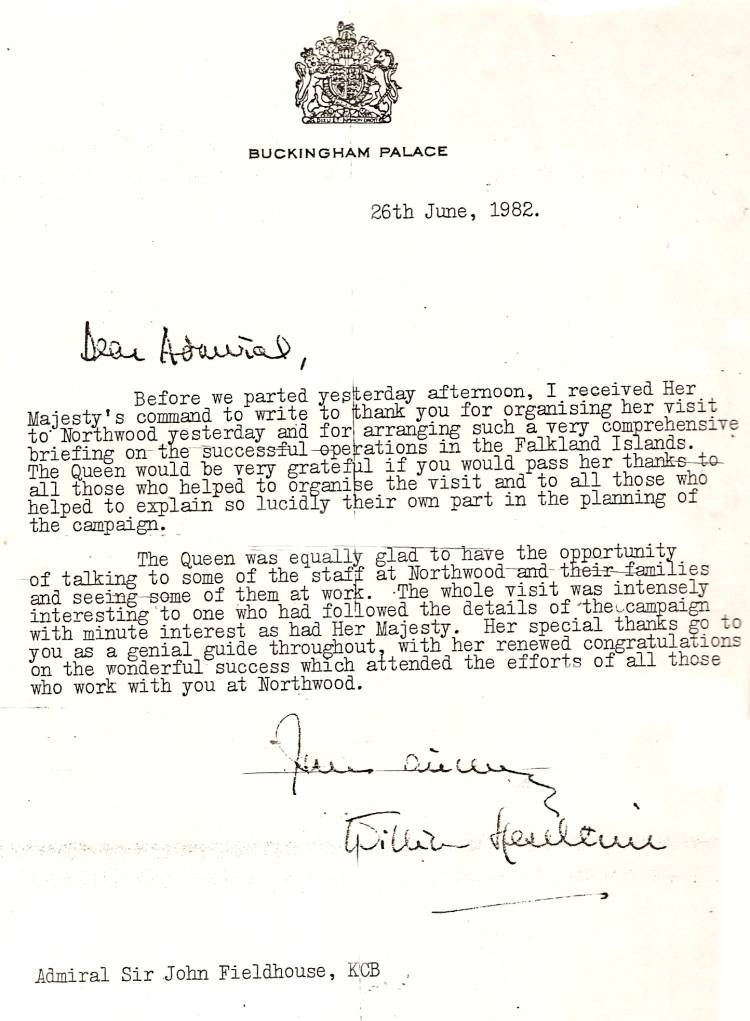
Praise indeed!
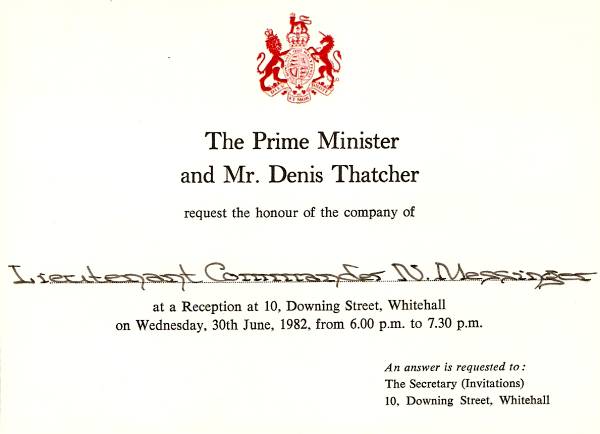
The great lady herself gave me a hug.....
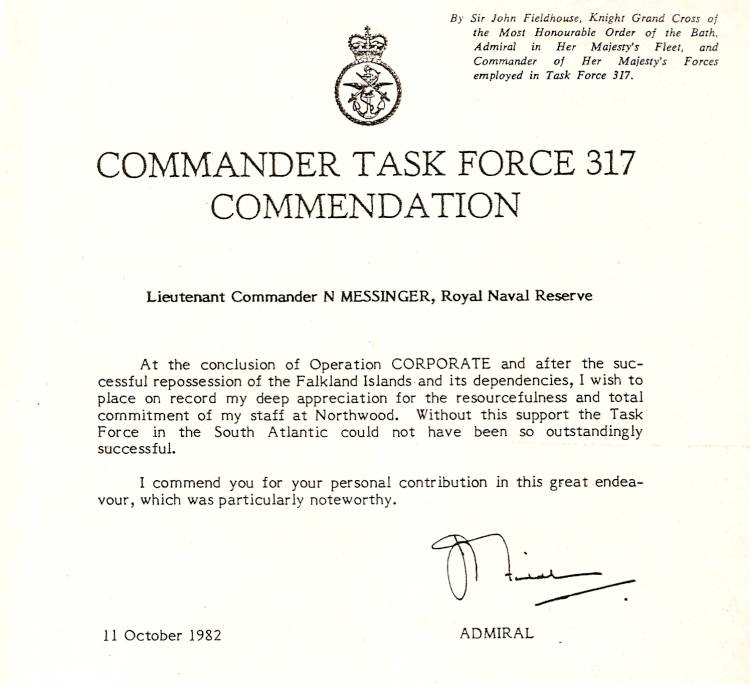
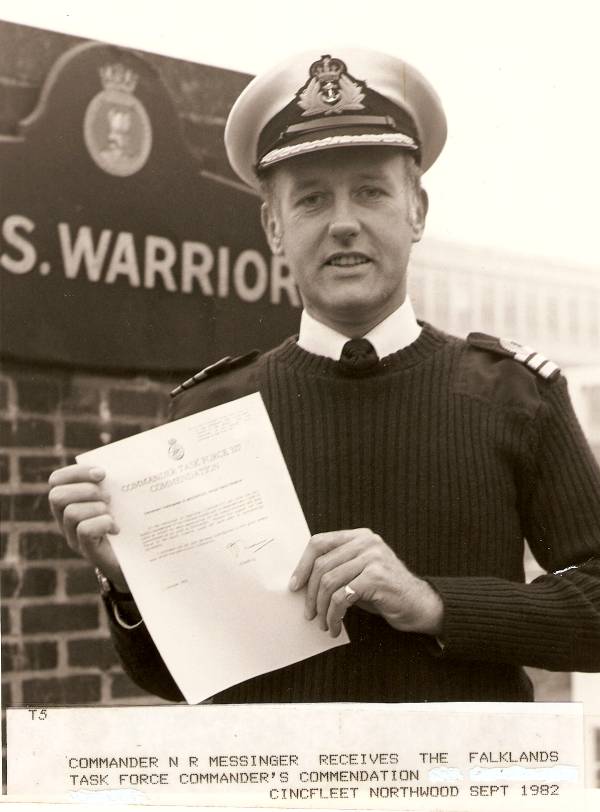
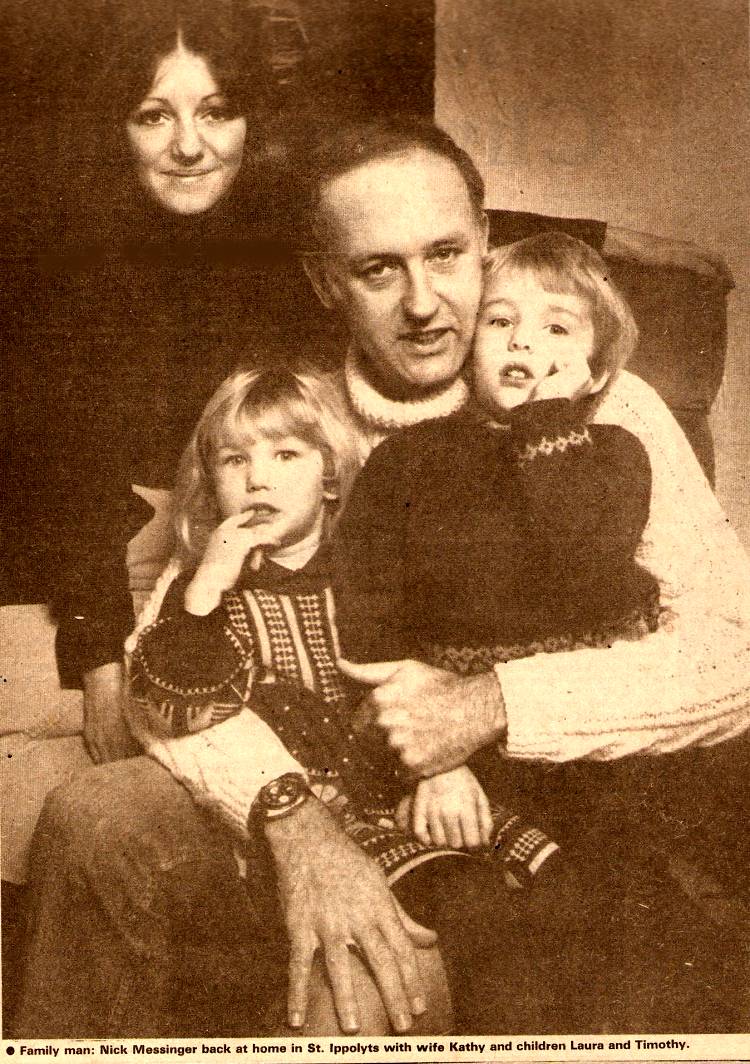
Home again.......
©Nick
Messinger 2012
www.nickmessinger.co.uk